
The Story of the Inchkeith Hounds from Hell
During my police career I specialised in two areas. For the first five years I was a dog handler and also a dog baiter. For the last seventeen years of my police service I worked on police boats. Both these specialities would come into play when I encountered the Hounds from Hell on the Island of Inchkeith.

Patrolling the Forth
The Island of Inchkeith is located in the Firth of Forth between Leith on the southern shore and Kinghorn in Fife. In the 15th and 16th centuries it was used to quarantine victims of syphilis and the plague. But in times of war it’s strategic position at the mouth of the Forth saw it fortified to defend against would be invaders. In 1804 the building of the 19 metre tall lighthouse was completed to help shipping navigate the local waters safely. Despite this, the skipper of HMS Britannia (not the Royal one currently berthed in Leith docks) failed to take heed of Inchkeith’s majestic lighthouse and managed to run his battleship aground on the rocky shores of the island.

The Island of Inchkeith
For me, the light played an important part in navigating the Forth whilst patrolling in the police launch during the hours of darkness. It’s light has 269,280 candlepower, with a range of 22 nautical miles.
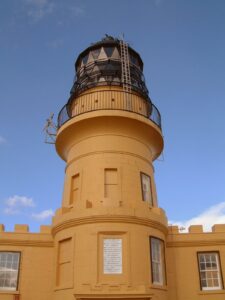
Inchkeith Lighthouse
When I first started working on the police boats, our vessels were somewhat primitive, and we didn’t venture too far from the naval base at Rosyth. But as the years went by, we upgraded our boats and the equipment we carried onboard. The police officers who crewed the vessels had to complete courses in navigation and safety equipment. As a result we became a much more professional outfit and took on more of a wide ranging role.
My first visit to Inchkeith was a voyage of discovery. The island was uninhabited at that time, but owned by Tom Farmer of QuikFit fame. We berthed the police launch at the sheltered harbour on the western side of the island and went exploring. The lighthouse stands proudly on the highest point of Inchkeith and it drew us uphill to investigate. With me that day were the two constables who made up my crew, Brian and Gordon (better know as Smithy). We followed the track from the end of the harbour wall, up through a collection of old derelict redbrick military buildings. Above us hundreds of angry sea birds noisily protested the invasion of their home. Gulls, fulmars and terns swooped around us as we made our way up the steep incline.

View as you enter Inchkeith Harbour with the lighthouse high above
Just below the lighthouse, the track passes through a deep cleft in the rocks. Brian was in the process of informing me that the cleft was better know as the ‘Grand Canyon’, when the inevitable happened. A large gull suffering from some horrible gastric complaint dive bombed us and struck with precision aiming. The contents of its rear end went straight down the back Smithy’s neck. What was a source of great hilarity for Brian and myself was a cause for considerable concern for Smithy. He ripped his jacket off desperately trying to scoop the foul mess out from under the collar of his shirt. It looked like melted ice cream with mint and chocolate chips through it. Unlike ice cream, this substance was hot and and it smelt of rotten fish.
With the three of us now wearing our fluorescent orange Seasafe jackets over our heads for protection, we continued our island exploration. The lighthouse door was unlocked, so up we went for a look around. From a police perspective the insecurity of the building was a concern and would need to be rectified.
A plaque on the wall reads,

“For the direction of mariners, and for the benefit of commerce, this lighthouse was erected by orders of the Commissioners of the Northern Lighthouses. It was founded on the 18th day of May in the year 1803, and lighted on the 14th September 1804. Thomas Smith, Engineer”.
I wondered if Smithy’s namesake had fallen victim to the dive bombing gulls of Inchkeith in 1803.
The lighthouse keeper’s cottages were all locked and had been unoccupied since 1986 when the light was fully automated by the Northern Lighthouse Board. One of the older buildings had a paved rain catchment area outside to collect fresh water. Inside the house we discovered the first wooden sink I had ever seen.

The old Lighthouse Keeper’s houses in the centre of the image
We spent about an hour on the island before returning to our patrols. It wasn’t until we were back within the confines of the police launch’s wheelhouse that Brian and I became aware of just how badly Smithy was smelling.
The following year the island got a new resident by the name of Kathleen Allan. Tom Farmer had advertised for a caretaker to live on the island and had been inundated with applicants. Kathleen was the one he selected, having been impressed with her reasons for applying. She ran an animal sanctuary somewhere in the Lothians. The owner of the land was selling up and Kathleen needed a new home for her collection of animals. Inchkeith island would be the ideal place for her menagerie. There were lots of buildings that could house animals and she could live in one of the lighthouse keeper’s houses.
We received the news that she had moved out to the island and when the opportunity presented itself I set the police launch on a course for Inchkeith. The plan was to introduce ourselves, let her know that the police launch patrolled the waters around her new home and that if she had any problems she could contact us for assistance via VHF radio. That was the official reason for the visit. If I am being truthful, a large part of the reason for visiting was nosiness. It is not every woman who would choose to live alone on an isolated island with a collection of animal waifs and strays. I was intrigued and looked forward to meeting her.

Police launch berthed in Inchkeith Harbour
My crew on that day consisted of Smithy and a constable called Kenny Hunter. The sea was calm and the sky was blue as we headed east down the waters of the Forth. It is not until you make the final approach to the island that you realise just how high and how steep it actually is. As I rounded the end of the harbour wall Kenny and Smithy made their way out onto the upper deck to prepare the berthing ropes. It was a beautiful warm day and the windows of the wheelhouse were wide open. As the launch glided gently along side the harbour wall Smithy jumped ashore with the bow rope and Kenny did likewise with the stern rope.
I had my head stuck out of the wheelhouse window to see exactly how the launch was coming alongside and to judge what correction I might need to make to the approach. It also made it easy to communicate with Kenny and Smithy.
It was just as they both jumped down onto the harbour wall that I first heard a noise I was not expecting to hear. It was the unmistakable sound of a large pack of dogs, howling, barking and snarling. The other thing of note about this canine cacophony was that it was getting louder very quickly. I stepped away from the wheel and moved to the starboard side to see where these dogs were. It was hard to miss them. A pack of dozens of assorted dogs were coming down the track from the lighthouse heading straight for the harbour wall where Kenny and Smithy were both now standing rooted to the spot. There were greyhounds, German Shepherd dogs, collies, mongrels both large and small.
The angle of descent meant that the dogs were covering several metres with every stride and were closing on my crew at a most alarming rate. Like rabbits caught in the headlights, Kenny and Smithy looked on in horror as the baying hounds charged straight at them. I, on the other hand, was a trained police dog handler and baiter. I had been on a course learning how to be attacked by dogs. I had spent three years playing the part of the bad guy who runs away for Police dogs to chase and bring down. I knew what it was to be bitten.
So, using all my experience, I kept a cool head and slammed the wheelhouse doors firmly closed and shut the windows. Well, there was no point in all three of us getting mauled, was there?
The outcome of the encounter with the dogs is related in the song. What is not included is the encounter with Kathleen Allan. We introduced ourselves to her and she introduced us to her family. There was Porky the pig who was beyond enormous, and was in love with a pony. There were several sheep, the Inchkeith Hounds from Hell, countless cats and Valery and the kids (goats).
That was the first of many visits to Kathleen who lived on the island until 1991. On one occasion I was working an overtime shift with a crew who had never landed on the island. So we headed out to Inchkeith to meet Kathleen. We took out fresh milk and bread for her as she had very limited access to fresh produce. We were standing next to the goat house chatting about the animals when Porky the pig quietly sneaked up behind one of my crewmen. Without warning Porky put his head between the constables legs and lifted him completely off his feet. I can still picture the look of sheer terror on his face to this day.
Porky remains one of the biggest pigs I have ever encountered. His love affair with the pony was proving a bit of a problem for Kathleen. Porky like to show his affection for the pony by biting it on the bum. No doubt from Porky’s perspective it was just an amorous nibble, but the pony was now developing sores on it’s rump. Kathleen had separated them to allow the sores to heal but Porky was having none of it. Gates and barricades were unceremoniously swept aside and destroyed by the lovesick pig who refused to be kept apart from the apple of his eye.

Heading west after a visit to Inchkeith Island
One wild wintery night we were not venturing to far away from the shelter of the naval base at Rosyth, when we received a call over the radio. Someone had reported to Fife Constabulary that there was a fire burning at the top of Inchkeith Island. We battened down the hatches and headed down the dockyard channel towards the Forth bridges. It was going to be a rough journey out to Inchkeith. We picked up a couple of officers from Burntisland Harbour who had received the initial call and headed back out into the darkness and the heavy seas. Initially they were very excited to be going out on a police launch for the first time. But as the conditions worsened and the waves crashing over the bow grew larger, they became very quiet indeed.
There are rocky reefs close to the harbour entrance at Inchkeith and it is vital to avoid them as you make your approach. The waves were sufficiently rough that they were being picked up by the launch’s radar. As a result the rocks were lost amongst the clutter of echoes on my radar screen. It is on occasions like this that local knowledge proves invaluable. I took a wider than normal approach to make absolutely sure that I was well clear of the rocks and entered the comparative calm of the harbour. Unlike other occasions, there was no sound of howling from a pack of excited dogs to greet our arrival. Just the howling of the wind.
The two Fife police officers seemed mightily relieved to set foot back on terrafirma. We could see the glow of a fire coming from behind the lighthouse and I was sure that it was not from the lighthouse keeper’s cottage where Kathleen lived. The noise of the storm, I was sure, had masked the engine noise of the police launch entering the harbour and it was therefor reasonable to suspect that our arrival had gone unnoticed.
We made our way up the track by torchlight, through the Grand Canyon and arrived at the lighthouse. It was from here that we could see a the source of the flames. A large mound of hay and straw was smouldering away several yards down the slope that faces towards Kirkcaldy.
One of the Fife officers spotted a light on in one of the lighthouse keeper’s cottages and like a moth drawn to the flame he headed straight for it. At this moment in time, Kathleen was stretched out in her living room peacefully reading a book. All around her, and in some cases, on top of her, were cats and dogs. She, and the dozens of animals which surrounded her, were blissfully unaware that we had landed on the island. After all, who would be out and about on a wild night like this? I arrived at the living room window just as the Fife officer banged loudly on the door. The scene that unfolded before me was one the likes of which, I will never see again.
As if a charge of T.N.T. had been detonated underneath them, every living creature in the room took off vertically and then formed a whirling chaos of fur, barking and screaming. As Kathleen’s book hit the ceiling, cats with eyes wide open in terror, leapt over dogs who in turn howled as the cats claws dug into them. The noise was deafening as twenty plus dogs did a canine version of the wall of death around the erstwhile tranquil room. The cats, who seemed to outnumber the dogs, tried desperately to avoid being bowled over by hysterical hounds by climbing up whatever they could, including poor Kathleen.
We may have established that she had come to no harm from the fire, but now the new risk of heart attack seemed a very real one.
Kathleen had had a hard day working in the animal sheds, cleaning out old bedding. She felt that the best way to dispose of it, and any parasites that may have been lurking in it, was to burn it. The straw and hay had generated a good going blaze which, from the mainland, gave the impression that the buildings around the lighthouse were on fire. From Kathleen’s perspective, the fire was a good distance away from everything else and had been blissfully unaware of the concerns for her well being.

The Hell Hounds of Inchkeith
When I was out a’sailing just of the coast from Leith
I chanced intae the harbour at the Island of Inchkeith
And as my crew were tying the boat up I heard these awful sounds
Aye coming down the hill side was a pack of forty hounds
They were barkin’ they were snarlin’ they were bearin’ all their teeth
And it looked just like the Hounds from Hell had landed on Inchkeith
But I know all about dogs Sir, ‘cause I’ve been bit before
So as quick as I could move myself I shut the cabin door
Now Kenny and young Smithy they had faces filled with fear
As I looked out of my cabin at them out on the pier
There was nowhere they could run to – for them it was too late
The Hounds from Hell were closing at a most alarming rate
A rabid looking greyhound he was leading out the pack
While a corgi with three legs it was chasing at the back
I couldn’t bring myself tae watch as my crewmen met their fate
‘Cause if I see the sight of blood I’m guaranteed to faint
So I cowered in my cabin and I wished them both “Adieu”
And I wondered how I’d sail my boat with out my trusty crew
But the Hounds were nearly on them – They made a dreadful din
And I listened as the Hounds from Hell ripped them limb from limb
Well I was shaking I was petrified I was just a nervous wreck
And then I heard the Hounds from Hell – they were on the upper deck
The cabin door flew open and the Hounds from Hell leapt in
Followed by Kenny and Smithy not missing a single limb
“As skippers go” young Smithy said “you’re just a dammed disgrace”
“The worst thing that these dogs’ll do is lick ye on the face”
“Aye, on yer feet” said Kenny “and explain the big idea”
“O’ shuttin’ yersel’ inside the boat leaving us oot in the pier”
Now Kenny went tae the starboard door and opened it quite wide
They grabbed me by the arms and legs and they flung me o’er the side
I was thrown intae the harbour by an angry mutinous crew
And then the Hounds from Hell decided they’d go swiming too
Well like a droon’t rat I waded from the sea
While the Hounds from Hell they swam aroon’ and barked and yelp’d wi’ glee
And as I struggled back onboard the boat wi’ my skin all turning blue
Kenny said “Dinnae settle yet – You’ve the Dog Watch yet tae do!”
So if you’re ever sailing just of the coast from Leith
And ye chance intae the harbour at the Island of Inchkeith
Be sure tae take along yer Pal – aye and yer Pedigree Chum as well
And you’re guaranteed tae make good friends with the Inchkeith Hounds from Hell


